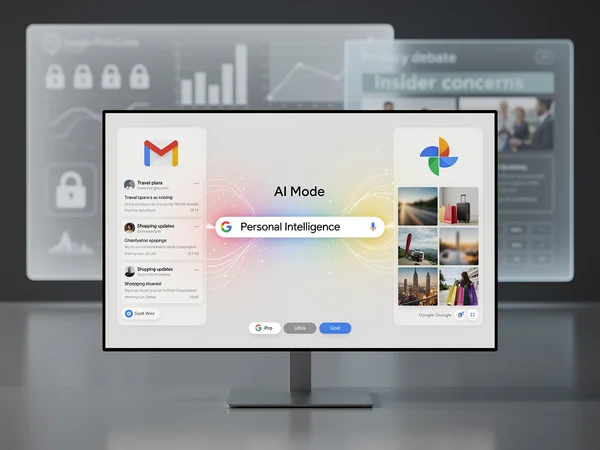
Google is pushing the boundaries of search personalization with Personal Intelligence in AI Mode, a feature that weaves users’ Gmail and Google Photos data into tailored responses. Announced on January 22, 2026, by Google’s blog , the opt-in tool aims to blend global web knowledge with private context, creating results that feel intimately relevant.
Robby Stein, VP of Product for Google Search, described how the system spotted a recent sneaker purchase from his emails and suggested a matching new style, leading to an instant buy. This marks an expansion from its debut in the Gemini app a week earlier, now rolling out as a Labs experiment for Google AI Pro and Ultra subscribers in the U.S. using English on personal accounts.
Powered by the Gemini 3 model, Personal Intelligence does not train on full inboxes or photo libraries—only on specific prompts and responses to refine functionality. Users enable it via Search settings: tap profile, select personalization, then connect apps. Feedback thumbs-down or follow-ups help correct errors, as Google admits the experimental tech may misconnect contexts.
Advertisement
article-ad-01Real-World Tailoring in Action
For family trips, AI Mode pulls hotel bookings from Gmail and ice cream selfies from Photos to recommend museums or parlors, as shown in Google’s demo video. Shopping queries factor in flight confirmations—like a March trip to Chicago—and past brands for windproof coats matching local weather and style preferences.
Creative prompts shine too: ‘If my life were a movie, what genre?’ draws from photos and emails for whimsical titles. 9to5Google notes this elevates AI Mode beyond generic lists, while Search Engine Journal highlights the U.S.-only Labs rollout over coming days.
Stein shared on X: ‘Personal Intelligence just landed in AI Mode – unlocking a Google Search experience that really *gets* you,’ praising its intuition for travel and style matches. Vikas Kansal, product lead for Gemini subscriptions, called it a ‘game changer’ for Pro and Ultra users.
Privacy Controls Amid Data Hunger
Opt-in is mandatory, with toggles in My Activity to disconnect anytime. Google emphasizes transparency in its Building Personal Intelligence PDF , but ABC News warns users must trust the system with life details like habits and itineraries.
The Verge reports no model training on private data, limiting it to improve prompt handling. Still, exclusions for Workspace accounts signal caution around business use. Early testers via Labs report seamless integration, though hallucinations persist, fixable by user input.
Industry watchers see competitive edges. Engadget positions it against rivals lacking such data moats, while X user Ejaaz noted Google’s speed in leveraging emails, photos, and history for personalized Gemini variants, outpacing OpenAI.
From Labs to Mainstream Stakes
Rollout invites hit eligible subscribers soon, per Google’s FAQ. Android Authority frames it as Search evolving from indexing the world to understanding individuals. Publishers eye impacts: personalized answers might bypass clicks, as Search Engine Journal ponders traffic shifts without analytics yet.
Jason Howell tested eight prompts on YouTube, from trip planning to shopping, lauding context from Gmail and Drive. Dataconomy cites Stein: recommendations ‘fit seamlessly into your life,’ reducing repetitive explanations.
For insiders, this fuses Gemini 3’s multimodal prowess with Search’s scale. Business Standard details past-behavior surfacing, like brand recognition in sneaker hunts. Limitations abound—no geo-tagging reliance, English-only—but feedback loops promise iteration.
Publisher and Competitive Pressures
Unlike traditional results, AI Mode resolves queries internally, raising SEO alarms. Barry Schwartz on X linked SERoundtable coverage of volatility around the launch. Ars Technica (implied in X buzz) questions verification amid personalization.
Google’s vision, per Stein, counters this by citing sources alongside personal insights. Digital Trends likens it to a digital memory, pulling trip weather and styles without prompts. Rivals like ChatGPT lag without native app data.
Expansion teases more apps, building on Gemini’s YouTube ties. Gadgets 360 confirms Labs exclusivity, urging manual enables. For Pro/Ultra payers, it’s a perk amplifying $20-50 monthly subs.
Broader AI Search Evolution
AI Mode, launched mid-2025, already handles long queries 2-3x traditional lengths, per Google’s I/O posts. Personal Intelligence accelerates this, enabling ‘perfect day’ imaginings from photo vibes. Yahoo Tech teases context unlocking ‘even more helpful’ responses.
X reactions mix hype and skepticism—’invasive’ privacy jabs versus workflow resets. Digit.in sees a shift to assistant-like Search, differentiating via data. As Labs feedback flows, expect refinements before wider release.
Google’s bet: users crave convenience over generic outputs. With 1.5 billion monthly AI Overview users by late 2025, per Sundar Pichai’s X post, Personal Intelligence could redefine retention in a crowded field.

LEAVE A REPLY
Your email address will not be published