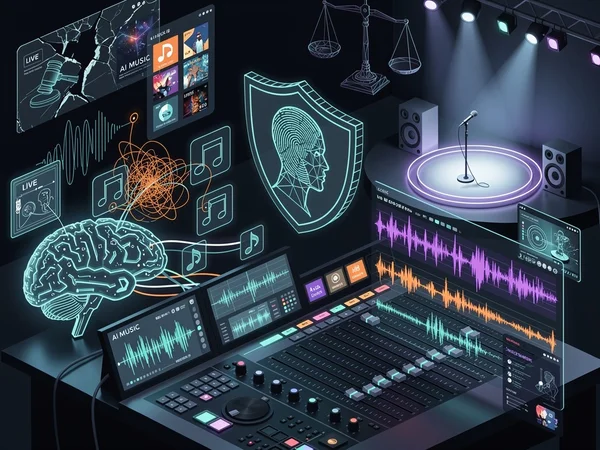
Will.i.am, the Black Eyed Peas frontman turned Arizona State University professor, sees artificial intelligence not as music’s executioner but as its next evolution. In a recent Squawk Box appearance on CNBC, he dismissed current AI-generated tracks as mere “AI slop,” the nadir of what’s possible. “This is the worst it’s ever going to be right now,” he told hosts, framing today’s prompt-driven outputs as primitive precursors to sophisticated, promptless systems ( CNBC Squawk Box ).
Drawing parallels to hip-hop’s sampling revolution, Will.i.am likened AI to 1970s jazz musicians decrying samplers. “Turns out that that’s the form of hip-hop sampling,” he said, crediting his own career to reimagining tracks like Dick Dale’s “Misirlou” in “Pump It.” Yet he stressed human creativity’s irreplaceable core, warning that developers training algorithms on vast music libraries must compensate creators. Looking ahead, he predicted AI evolving beyond yesterday’s data, creating original works—a future the industry must prepare for.
Advertisement
article-ad-01Fragmentation plagues modern music discovery, Will.i.am argued, with Spotify’s rising pops often TikTok-fueled ephemera. “Everything is now fragmented,” he noted, contrasting communal MTV eras with today’s attention onslaught. Summer anthems endure briefly, if at all, devaluing music via streaming payouts far below vinyl or CD peaks.
Live’s Enduring Premium
In this deluge, live performances emerge as the ultimate moat. “We’re going to get to a point where live is the place to be. You can’t trust the screen in a couple years,” Will.i.am forecasted, invoking lip-sync scandals and Grammy backing tracks. Indistinguishable AI from human output will demand verifiable human improvisation, elevating theater and concerts as authentic havens.
His optimism tempers tech enthusiasm: human-made art regains value amid abundance. Recent industry moves underscore this. Bandcamp banned AI-generated songs to protect organic creators, citing an influx diluting discovery ( The Hollywood Reporter ). Sweden disqualified a partly AI folk-pop track from charts despite Spotify streams, sparking transparency debates ( RouteNote Blog ).
Forbes warns AI could decimate copyrights unless licensing solidifies, with 2025 seeing viral AI tracks blurring human-machine lines ( Forbes ; CNBC ).
Agents in Every Home
At ASU’s “Agent Itself” course, co-developed with Eduify, Will.i.am equips students to build personal AI agents on Nvidia GPUs. “You need your own agent,” he insisted on CNBC, likening it to essentials like bank accounts or email. With over 100 students—demand exceeding caps—graduates earn certificates for agents with lived credentials, countering job displacement.
Nvidia’s Jensen Huang supplied GPUs, enabling students to “marry and mint” bespoke agents. This shifts from shared village AIs like ChatGPT or Gemini to sovereign digital twins, primed for a workforce where agents replace humans sans experience.
Saving Country Music enacted a 2026 AI ban policy, deeming it an existential threat to human integrity ( Saving Country Music ). Suno’s $2.45 billion valuation fuels fears, its CEO embracing the “Ozempic of music” moniker amid slop proliferation ( The Guardian ).
Owning Your Doppelganger
AI likeness looms largest for creators like Will.i.am. Unauthorized doppelgangers—singing, teaching, storytelling—threaten without ownership. “The reason why that’s a bad thing now is because you don’t own your agent,” he said, citing potential Asian variants or CNBC clones of hosts. Ownership mirrors financial safeguards: name, image, likeness banked securely.
We’re in the “wild wild west,” he declared—no sheriff, no accountability for data gunslinging. Regulations must balance safety and innovation. Yapsody forecasts 2026 U.S. copyright clarity on voice cloning, urging artist adaptation ( Yapsody ).
CISAC’s study flags generative AI risking creators’ futures, demanding transparency ( CISAC ). Music Ally charts 2025’s AI lexicon, eyeing 2026’s zero-sum games ( Music Ally ).
Fragmentation’s Hidden Toll
Beyond AI, streaming’s fragmentation erodes superstars. Taylor Swift thrived on MP3 sales; today’s TikTok acts chase virality, not longevity. Will.i.am questions Beyoncé-scale replication in DSPs devaluing tracks. Live revenue surges, but screens’ distrust accelerates this pivot.
Posts on X echo concerns: AI flooding zones prompts platform stands, while evangelists tout data as the counter. Fast Company argues embracing AI tools benefits artists over suppression ( Fast Company ).
Sweden’s chart ruling and Bandcamp’s ban signal tipping points. Digital Watch Observatory notes unprecedented AI track surges, questioning synthetic artist authenticity ( Digital Watch Observatory ).
Regulatory Reckoning Ahead
Laws lag innovation, but momentum builds. Will.i.am predicts a “gunslinger” sheriff soon. With AI music’s viral rise—per CNBC—industry survival hinges on licensing, as Forbes details. Personal agents via home GPUs democratize power, but only with IP fortresses.
Will.i.am’s dual role—performer, educator—positions him uniquely. His ASU push, Nvidia-backed, previews agent economies where diplomas extend to digital selves. As AI slop yields to originality, music’s human essence endures in live authenticity and owned identities.
LEAVE A REPLY
Your email address will not be published