
There's something about Christmas trees that brings out the mischief-maker in cats. With their flickering lights and dangling decorations, they're the perfect temptation for our feline friends.
Adorable as that might be, it's not great for the festive ambience. Rather than choose between a happy cat and the perfect tree, read on to learn our top tips for cat-proofing your Christmas tree and keeping your pets safe this Christmas season.
Key Takeaways
Artificial Christmas trees are less tempting to cats because they have no smell and a less appealing texture. If you do want a real tree, then a Fir tree is the most pet-safe option.
Make sure your tree is secured at the bottom and top to prevent it from falling over if your cat does get inside.
Using a cat deterrent can help dissuade your cat from getting too close to your tree, but a fire barrier or gate can also help!
Are Christmas Trees Safe for Cats?
Cats are naturally curious creatures who love nothing more than inspecting new additions to the home or exploring new areas. They also love things that dangle and things they can climb.
With this in mind, it's no wonder that cats climbing Christmas trees is a common problem.
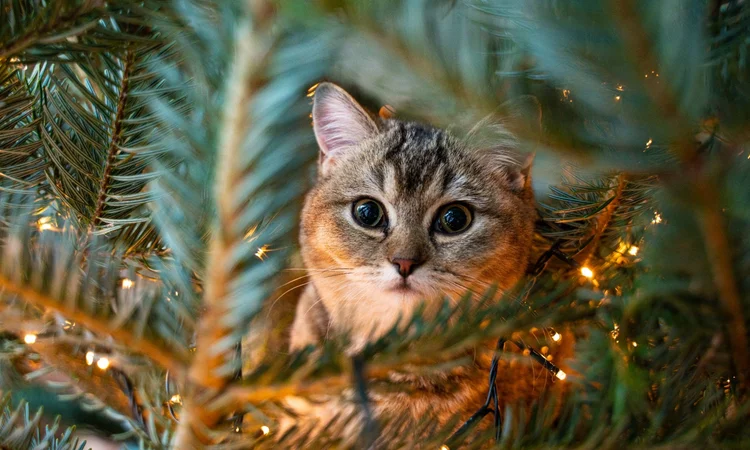
While seeing your cat in the Christmas tree might be an adorable photo opportunity, it can pose a risk to your cat's health, such as:
Broken decorations, which could leave sharp edges
Harm to your cat if they step on, chew, or swallow any needles
Harm to your cat (and your decorations) if they pull the tree down, especially if your cat is still in the tree
Electrocution if you cat chews any lights or wires
Why Do Cats Climb Christmas Trees?
Cats are naturally curious creatures who love nothing more than inspecting new additions to the home or exploring new areas.
So, when you suddenly erect a tree in the middle of your home covered in tantalising tinsel and hanging decorations begging to be swatted, it’s no wonder your cat is intrigued.
This can often lead to your cat knocking off decorations, climbing into the Christmas tree, and even pulling the whole thing down in their attempts to do so.
Are Real Christmas Trees Safe for Pets?
Before we delve into the best pet-safe Christmas trees, we first need to look at what a "real Christmas tree" is.
Most real Christmas trees available to buy are one of the following:
Norway Spruce
Nordmann Fir
Lodgepole Pine
Of these options, the most pet-friendly Christmas tree would be a Nordmann Fir because of its blunt needles.
Pine, in particular, should be avoided due to their stronger, sharper needles, which can prick paws, cause mouth irritation or gastrointestinal problems if swallowed. Pine oil and sap is also toxic to cats if ingested, although the severity varies depending on how much your cat ingests.
How to Cat-Proof Your Tree
To keep your cat safe this Christmas and ensure the longevity of your Christmas tree, here are our top tips for cat-proofing Christmas Trees:
Consider an Artificial Tree—Cats are less likely to chew a fake christmas tree since the scent and texture is less appealing to them, and has no needles so prevents any acidental ingestion or hurt paws.
Secure your tree—use a heavy, sutdy base or tree stand and secure the top of the tree to the wall or curtain rail to keep it upright.
Wait to decorate—put up your tree and then leave it bare so you cat can adjust to the new addition. Then start decorating in stages.
Avoid decorating the bottom—this part of the tree is right in your cat's eyeline, so try to keep decorations higher up so they're not tempted to play with any baubles or tinsel.
Keep lights close to the trunk—this will make it much harder for your cat to chew any lights or wires. Ensure you keep the cables tucked away too, or hidden beneath a cover.
Avoid edible decorations—the smell of food on a tree could entice your cat futher, and many christmas decor (such as orange peel, dried citrus fruit, and chocolate) are toxic to cats if eaten, so are best avoided.
Avoid fake snow—fake snow is often made from chemicals that are toxic to cats, and fake snow in a can can upset your cat's delicate respiratory system.
Keep away from furntiture—your cat could use sofas, armchairs, or other furniture as a launch pad into the tree, so keep your tree a good distance from any furntiure.
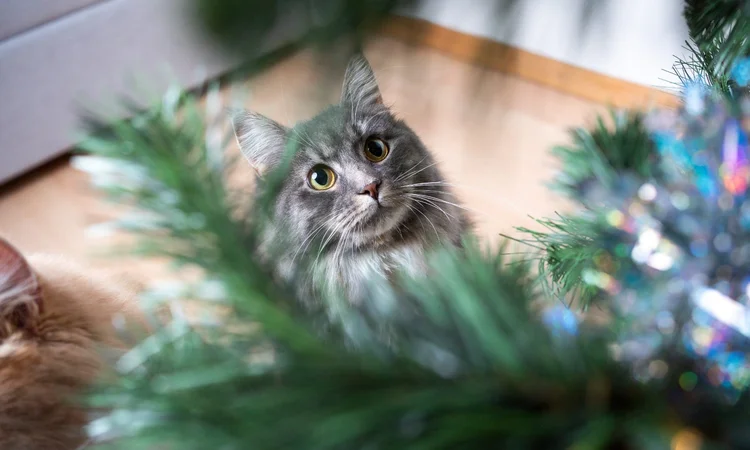
How to Keep Cats Away from Christmas Trees
As well as ensuring your tree is safe for your cat should they get their paws on it, there are also steps you can take to keep your cat away from your tree entirely, such as:
Putting up a barrier or fire gate around your tree, your cat can’t get over easily.
Keep your tree in a pet-free room so your cat doesn’t have constant access to the tree.
Try using tinfoil around your tree - Most cats hate the feel and sound of tinfoil, so placing it beneath your tree can keep them at arm's length. Be careful, though, as tinfoil is harmful to pets if ingested.
Keep catnip cat toys far away from the tree. Even if you’ve wrapped some for your feline friend to get on Christmas day, your cat can smell the catnip and find themselves in a very playful mood afterwards.
Use non-toxic cat deterrents on and around your tree to keep them away. Things like this, Grannick's Bitter Apple Spray, have a bitter taste and smell that your cat will not appreciate, and should keep them away.
Distract your cat with new cat toys, such as puzzle toys, boredom breakers, or even a new cat tree to make the tree less appealing in comparison.
If all else fails, you can always choose a much smaller Christmas tree that won't entice your cat as much and doesn't offer sufficient space to climb or cause any damage.
Christmas is an exciting time for everyone, including our pets. By keeping things as safe and protected as possible, your holidays can go off without a hitch!





Leave a Reply
Your email address will not be published.